A question I often get from the people around me is “Why did I choose to study scent in Japan?”
Yes, Japan is a land of the way of Zen and the way of virtue, far quieter than the bustle and glamour of Paris, the City of Light. Nor is this country known as a perfume kingdom like Grasse in the West or Kanauj in the East.
How should I explain it?
I think, at its deepest, for me it comes down to the word “Duyên,” a fated affinity. My destined bond with this country goes back a very long time. It is a second homeland that holds so many memories, milestones of growing up, and even my understanding of how I see the world.
In Japanese culture there is a concept called 迷惑 (meiwaku), meaning to bother others. The Japanese regard being attentive and helping others in hard times as a matter of great weight in their personal values, but conversely, they are very reluctant to… be a bother. Making others go to trouble on your account is seen as shameful. Perhaps that is why a clean, safe, quiet country is the impression most people who have been there come away with.
And it is the same with scent 🙂
For many Japanese, letting others notice your scent is a form of imposition. Or, more precisely, a form of ostentation – showing off. East Asian culture values harmony, in which each individual is small and attends to the consensus and rules of the community and society. This is especially valued in Japan. Western culture, on the other hand, puts emphasis on the self. Each individual is encouraged to express themselves, in the belief that a colorful self makes for a diverse, thriving society.
So what does that culture mean for scent?
I think, somewhere along the line, perhaps it leads to a restraint on revealing the individual self through scent? Unlike fashion, where Japan has Yohji Yamamoto or the fashion hub of Harajuku, scent has a different dimension. You can cover your eyes and plug your ears, but with scent, when its molecules drift through the air, you have no choice but to let your sense of smell do its work. Oh, and smell, through scent, is the one that reaches the brain fastest of all the senses, you know.
Some of my stylish friends once told me that scents from Japan, Korea, or East Asia in general are mostly… too monotonous! Too light! Too narrow in sillage! Scents with an Asian impression lean toward single notes and nature – rose, jasmine, orange, lemon, peony, bitter woods… simple, clean, easy to wear, easy to use… I find this fairly true, and it is why JO MALONE, and most recently AERIN, have been especially successful in the Japanese market.
A scent that people notice from afar, alluring, sparking curiosity (to the point that they sometimes ask what perfume you are wearing today)… is certainly not what most Japanese would choose. Nor do they seek to have others admire their scent. Very different from the West, where “you smell wonderful” is a wonderful compliment, and conversely, “you stink” is the most confidence-shattering thing you could ever utter.
And yet, that does not mean the Japanese do not love scent. With the arrival of Buddhism in Japan, people began using many kinds of fragrance from the woods and resins of nature. This laid an important foundation for the later emergence of the Way of Incense (香道 – Koudou – incense ceremony). I love Koudou, and it is one of the biggest reasons that brought me to Japan. The way of incense – this will be a very long subject; I will write more about it in a separate topic.
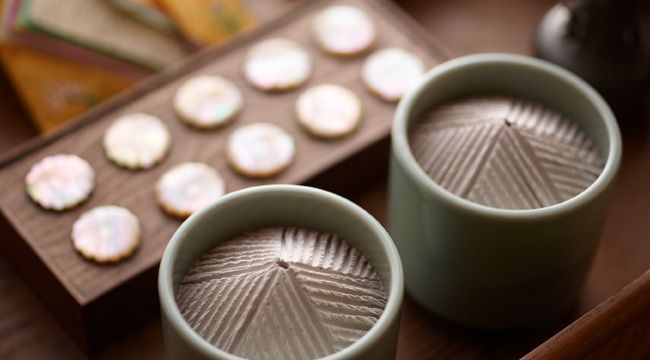
A serene space with a scent close to nature is something the Japanese care about especially. The Japanese love incense in worship, scent sachets tucked beside the kimono to keep their garments fragrant, or the fragrance of Hinoki wood that follows them from sacred shrines to the humble Ofuro bath. Fragrance is used widely in spaces and in daily life. In spring, heaven and earth are steeped in the pure scent of sakura; summer brings gardenia; autumn, the scent of osmanthus; and winter, for me, is narcissus. An older friend once told me she senses something called the “Japanese smell” very strongly but can never put it into words. Simply hugging a Japanese friend, or, funniest of all, just stepping out of the airplane door, and she can already sense that scent. That’s how it is: every place we go has a scent. And that scent is bound up with memory.
For me, the scent of walking through Omotesando, Harajuku, Shinjuku, Shibuya, Roppongi… or anywhere in Tokyo differs so much from place to place. Omotesando has many pines, and graves; I remember a May afternoon walking past a peaceful cemetery and feeling the sacred blending of the living and the dead… here, a cemetery does not feel desolate, but is simply a part woven in with the living. Still close, still brimming. Or Harajuku, the smell of powder and street dust. Confined. Rebellious. Chameleon. Unconventional.
And, you know what, scent in the Japanese mind is in transition.
Young people in Japan, stepping out into the world, have absorbed its culture, including the culture of scent. Isetan is where I can find most perfume brands, both commercial and niche. Every year, around November, Isetan holds a fragrance week, gathering all the most celebrated brands to exhibit and host a whole series of different scent talk shows. This is when I meet most of my seniors in the industry, and even my idols in the field of perfume making.
This moment, from the traditional values of the Way of Incense to new ideas about wearing and enjoying scent, is a moment of transformation for Japan.
And there are so many wonderful brands, Fragrance R, Tobali, Garment… all young and talented. I admire those seniors immensely.
Come to Japan, and you must buy Japanese perfume – that, I think, is very near now.
Tokyo, December 19, 2018