Essential oils are used as a wondrous natural therapy. Since ancient times, nature itself has been medicine. By living on the plants that nature bestows, humans keep their health and spirit in balance.
An essential oil, true to its name, is the essence of a plant in the form of a thick, oil-like liquid, the result of a long distillation process carried out by various methods. The methods known today include:
- Enfleurage – separating the aromatic substances of flowers:
It is usually applied to flowers with thin petals whose essential oil is very difficult to obtain, such as jasmine and ylang ylang. This is one of the very old handcrafted methods, originating in France. To obtain the essential oil from the delicate petals, a layer of animal fat called pomade is spread onto iron frames, and the flowers are laid on top. The fat slowly absorbs the essential oil from the flowers, just as the flowers gradually wither. Afterward, this fat is dissolved in alcohol and heated. Once the alcohol has completely evaporated, what remains is the essence – the absolute. This process is very painstaking and time-consuming, but it is the only way to obtain the essential oil of delicate flowers that wilt easily before their oil can be extracted, such as jasmine. An absolute is of the finest quality, preserves the scent almost exactly as it is in the fresh flowers, and is very expensive.
This is the very method that Grenouille in “Perfume” used to capture the scent of the victims and create a perfume said to be capable of dominating human emotions.
- Cold pressing
Cold pressing is a method of obtaining essential oil from the peels of plants. This method uses no heat or solvent of any kind. Most citrus essential oils are extracted this way, including pomelo, lime, lemon, and orange essential oils.
In terms of extraction technique, it can hardly be called an essential oil in the full sense. However, essential oils extracted by cold pressing are also regarded as having therapeutic properties. Even so, one important factor in this method is the source of the plant material. Because the peel is what is extracted, any insecticides or pesticides on its surface will affect both the quality and the scent of the essential oil.
- Steam distillation
Steam distillation is the most common method to date, used for the majority of essential oils. When it comes to essential oils with therapeutic properties, cold pressing and steam distillation are the two foremost methods. If an essential oil is not extracted by one of these two methods, it usually has no therapeutic properties.
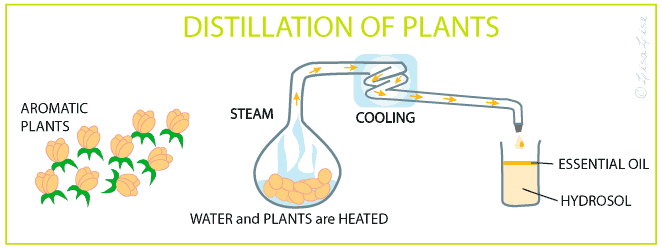
Image: The steam extraction method – Source: google
First, the herbs or raw materials to be extracted are placed in the still together with purified water. The purity of the water must meet the standard to ensure the highest quality for the extracted oil. In the steam extraction method, heat applied beneath the still makes the steam rise, carrying the essential oil with it along the pipes; when it passes through a cooled section of pipe, the steam condenses into droplets, yielding a mixture of hydrosol and essential oil.
The essential oil forms a very thin, pure layer; being heavier, it floats on the surface of the hydrosol. Hydrosol, also known by names such as herbal water or distillation water, is the herbal water that carries within it an amount of essential oil of about 0.02%. Once all the hydrosol has been separated off, we obtain the pure essential oil. The collected hydrosol is a precious material that can be redistilled for essential oil, or filtered again in a separate process to thoroughly remove organic residues and then used for skin care and health purposes.
- Solvent extraction
To date, this is the method used predominantly in the perfume industry. The extraction process uses chemicals such as hexane, acetone, di-methylene-chloride… For this reason, the extracted substance is not regarded as a therapeutic oil, but simply as an aromatic oil used as a raw material for making perfume.
In this method, the plant material is immersed in a solvent solution to become a solid – called a “concrete.” When this solid is placed in alcohol, the oil particles are released. The oil separated from this compound is used in most fragrance, beauty, and care products today (nearly 98%). These products include shower gels, soaps, scented candles, deodorants, toothpaste…
The great advantage of this method is that it saves a great deal of time and cost, while its yield far exceeds that of steam distillation. For purely aromatic applications, with nothing therapeutic or spirit-healing about them, this method is still regarded as the leading one for industrial fragrance.
From my point of view, I have absolute faith in therapeutic oils. Because only essential oils that are pure and distilled by the right method inherit the power and the magic of Mother Nature. It is as if plants transfer life from their bark, stems, leaves, and flowers into another form, yet still carry “fairy dust” within. And the healing magic of fairy dust is eternal.
Sài Gòn, August 20, 2017
Rei